Home › Frameworks › DORA

DORA compliance, from ICT risk to the third-party register.

The DORA articles become 27 recurring controls with owners and evidence. Incident classification, resilience testing and the register of contractual arrangements stay current, hosted in the EU. Included in Enterprise, €499 a month.

When did you become aware?

Indicative. Clocks run from awareness; check your national law and the full calculator for options such as trust service providers or a fix date.

Articles 5-15ICT risk management framework: governance, identification, protection, detection, response & recovery, learning & evolution, communication.
Articles 17-23ICT-related incident management, classification (Article 18) and reporting.
Article 26-27Threat-led penetration testing (TLPT) on at least a 3-year cycle for significant entities.
Articles 28-44Third-party ICT risk: register of contractual arrangements (Article 28), concentration analysis, exit strategy, sub-contracting controls.

What is DORA?

EU Digital Operational Resilience Act (Regulation (EU) 2022/2554). Banks, investment firms, payment institutions, insurance and reinsurance undertakings, crypto-asset service providers, central counterparties, trade repositories, and the ICT third-party providers serving them.

Selling software to financial entities rather than being one? Read DORA for SaaS vendors.

Who needs to comply

  • Banks and credit institutions
  • Investment firms, payment and e-money institutions
  • Insurance and reinsurance undertakings
  • Crypto-asset service providers under MiCA
  • Critical ICT third-party providers serving any of the above

Key DORA controls covered by Dazr

Articles 5-15ICT risk management framework: governance, identification, protection, detection, response & recovery, learning & evolution, communication.
Articles 17-23ICT-related incident management, classification (Article 18) and reporting.
Article 26-27Threat-led penetration testing (TLPT) on at least a 3-year cycle for significant entities.
Articles 28-44Third-party ICT risk: register of contractual arrangements (Article 28), concentration analysis, exit strategy, sub-contracting controls.

What auditors look for

DORA supervisors look for an ICT-risk framework approved by the management body, a third-party register with concentration analysis, recent TLPT evidence, and a major-incident classification trail. Dazr holds the controls and evidence for each of these four areas.

How Dazr helps with DORA

With Dazr Compliance you can:

  • Maintain the ICT-risk framework as recurring controls reviewed by the management body
  • Keep ICT third-party providers in the vendor register and run the concentration-risk assessment (Article 29) as a control
  • Track TLPT planning, execution and remediation as cyclical controls (at least every 3 years for significant entities)
  • Log ICT-related incidents with severity, timestamps and authority references, with Article 18 classification and Article 19 reporting as controls
  • Hand the supervisor a single PDF audit trail or a read-only audit view
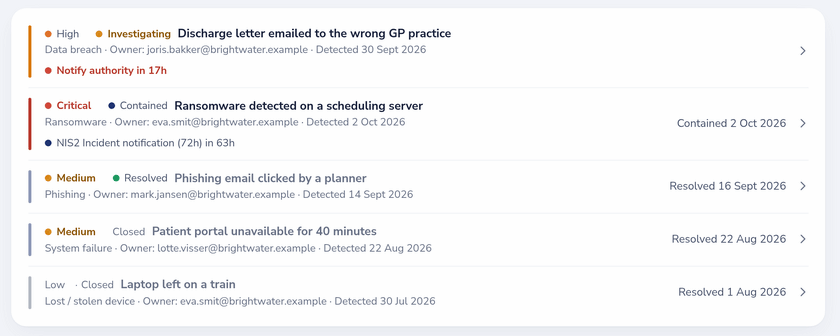
Incident register with a GDPR notification countdown and a NIS2 incident-notification milestone
The register with a GDPR notification countdown and the next NIS2 milestone.

Back to the full Dazr Compliance overview › | Sign up free ›

DORA questions, answered.

What is the difference between DORA and NIS2 in this platform?

NIS2 is a directive transposed by member states; DORA is a regulation that applies directly. They overlap on incident reporting and on supply-chain / third-party risk; they differ on TLPT cadence (DORA explicit) and on the register of contractual arrangements (DORA-specific). Dazr lets you enable both; the controls stay distinct.

Do you support TLPT scoping?

We track the TLPT cycle as a recurring set of controls (scoping, red-team execution, blue-team review, remediation). The actual TLPT engagement is delivered by an external red team you contract with; Dazr is the system of record.

Can I use Dazr if I am a Tier-1 critical ICT third-party provider?

Yes. The Custom tier covers the multi-entity setup, dedicated CSM and the procurement-friendly contracting that Tier-1 ICT providers typically need.

Where is data hosted?

European Union only. Workspace records are encrypted at rest with AES-256-GCM at the application layer; uploaded evidence files rely on the storage provider's at-rest encryption. Italian entity, EU jurisdiction.

Start your DORA program.